
CEFR B2(中上級) | British English | 1,407 words
はじめに
ピーターラビットと聞いて、皆さんは何を思い浮かべるでしょうか。
青い上着を着たウサギ、マグレガーさんの畑、手のひらに収まる小さな絵本。
そこへ『キャラクタービジネスの先駆者』という言葉を加える人は、あまり多くないかもしれません。
しかしビアトリクス・ポターは、絵本の成功からわずか1年ほどで、自らピーターの人形を縫い、1903年12月に意匠を登録しました。
ボードゲームの試作や壁紙などの企画にも関わり、商品の形や品質を細かく確認しています。
かわいい登場人物を生み出しただけでなく、その登場人物が絵本の外へ出たとき、何を守るべきかまで考えていたのです。
2026年はポター生誕160周年、翌2027年はピーターラビット125周年に当たります。
いまも世界中で商品や企画が生まれ続ける姿を見ると、1903年の小さな手縫い人形が、現在へ続く長い入口だったことが分かります。
今回のエッセイでは、ポターを単純な『経営の天才』として持ち上げません。
芸術と商売、拡大と品質、変化と一貫性の間で、彼女がどのように判断したのかをたどります。
ブログや作品を育てている人にとっても、自分の仕事を広げながら、大切なものを失わないためのヒントが見つかるはずです。
The Rabbit Who Left the Book
When a Rabbit Became More Than a Story
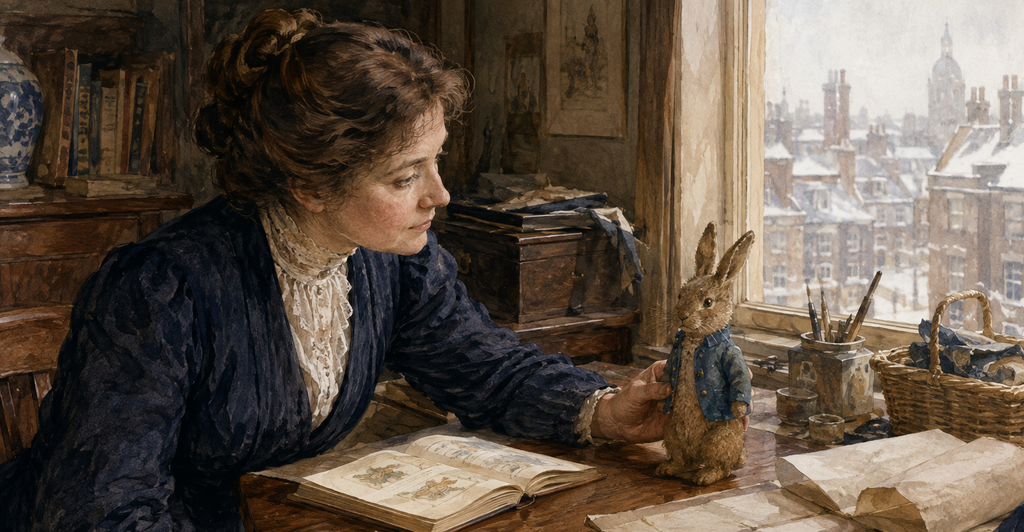
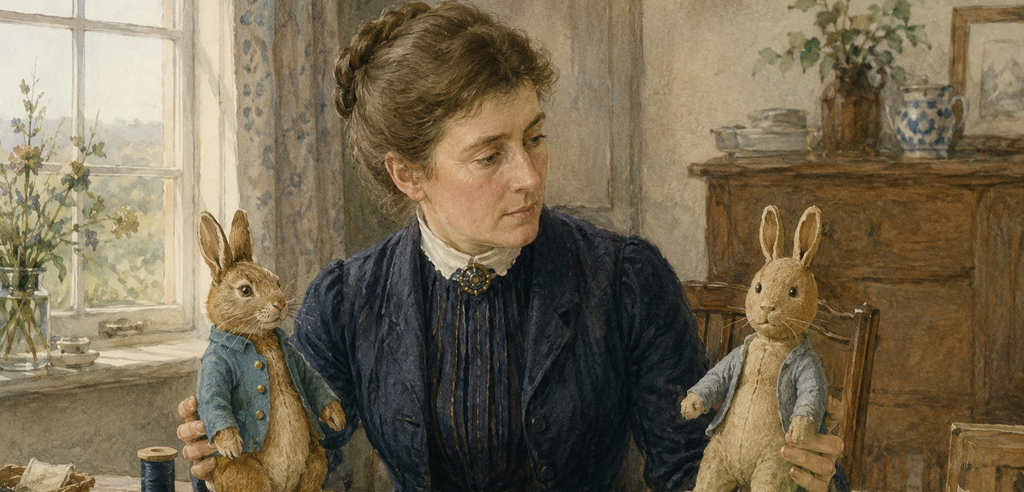
In December 1903, a small rabbit stood on a desk in London. He had brown fur, upright ears and a blue jacket. He was recognisable, but he was not made of paper. Beatrix Potter had sewn him herself.
Only the year before, The Tale of Peter Rabbit had been published commercially by Frederick Warne. The book was already a success, and success had produced a new problem. Peter was no longer protected by the edges of his little white book. Other people could imitate him, manufacture toys and decide what he looked like in the hands of a child.
Potter understood something that now seems obvious: a popular fictional character can have a life beyond the original story. At the beginning of the twentieth century, however, the modern system of character licensing barely existed. Authors wrote books, publishers sold them, and toys belonged to a largely separate trade. Potter began to connect those worlds.
Her response was practical. She created a prototype Peter Rabbit doll and registered its design at the Patent Office in December 1903. The official Peter Rabbit timeline describes this as the beginning of a long line of authorised products. Historians often call Peter one of the earliest licensed literary characters. It is safer to say that Potter was an important pioneer than to award her a simple world-first title, but the timing remains remarkable.
The familiar image of Potter as a private woman painting gentle watercolours is therefore incomplete. She was also asking a distinctly modern question: if a story becomes valuable, who decides what happens to it next?
The Doll She Designed Herself
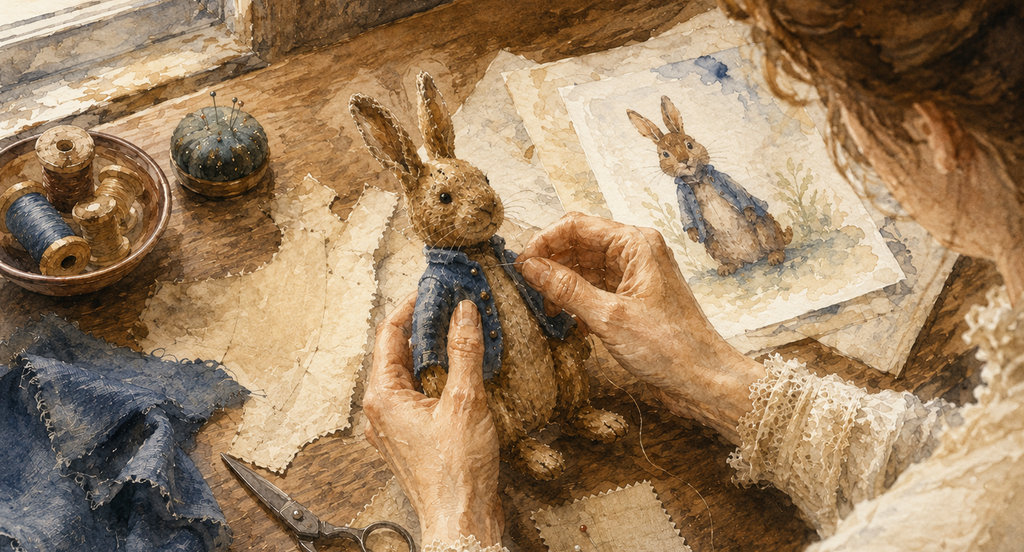
Potter did not begin with a licensing presentation or a marketing department. She began with cloth, thread and a pair of scissors. Her first doll was an experiment made by the same hands that drew Peter. This mattered because she was not merely placing a name on a product. She was translating a character from one material into another.
Translation creates difficult choices. A painted rabbit can be delicate in ways that a toy cannot. A doll must stand, bend, survive being carried and still look like the character. Potter investigated manufacturers and paid close attention to fur, shape, expression and clothing. According to accounts based on her correspondence, she wanted the doll made in England and disliked badly proportioned rabbit toys already on sale.
That attention was not vanity. Children meet a character through details. The blue jacket, alert ears and slightly anxious confidence tell us that this is Peter before anyone reads a label. If the face is wrong or the body becomes a shapeless bundle, recognition weakens. Potter grasped that a product could either strengthen the world of the books or quietly damage it.
There is also a lesson here about creative work. People often speak of expansion as if it were a simple matter of making more: more formats, more products, more markets. Potter's method began elsewhere. She asked what must remain true when the form changes. The doll could not reproduce a watercolour, but it could preserve Peter's character.
Today we might call this brand consistency. Potter would probably have used less flattering language when a sample looked wrong. The principle is the same: growth is useful only when people can still recognise what they loved in the first place.
Side-Shows with Serious Rules
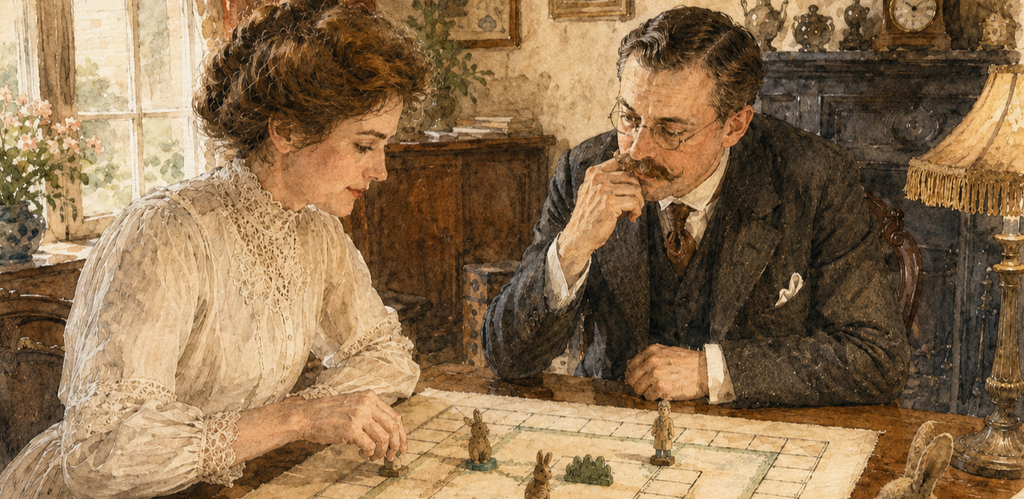
The doll was not an isolated idea. Potter developed other projects around the tales, sometimes calling them her 'side-shows'. One of the most revealing was a Peter Rabbit board game. Mr McGregor pursued Peter across a path of squares, while players tried to reach safety. Norman Warne, Potter's editor and later fiancé, helped by carving playing pieces for the prototype.
Potter wrote detailed rules, partly, as she joked in a letter, to prevent arguments. The game was registered, although it did not reach the market in its original moment. That failure is useful. A pioneer does not always produce a successful product. Sometimes the value lies in seeing a possibility before the surrounding business is ready to use it.
Other extensions followed over the years: painting books, designs for nursery wallpaper and a growing variety of authorised objects. Potter reviewed proposals and expected manufacturers to respect the appearance and spirit of her animals. Merchandise was not simply attached to the stories after they became famous. It was treated as another part of the created world.
This approach separates Potter from the stereotype of an artist who was accidentally successful. She understood price, format, royalties and ownership. She had already insisted that her books should be small enough for children's hands and affordable for families. The same practical intelligence entered her side projects. A product had to make sense for the person using it, not merely for the person selling it. The phrase 'side-show' sounds modest, almost apologetic. Yet side projects can reveal the future of the main work. Peter Rabbit was becoming more than a title on a bookshelf. He was becoming a relationship that could continue through play, objects and repeated recognition.
Popularity Was Not Enough
Popularity creates opportunity, but it also attracts imitation. Potter became more protective when she saw unauthorised or poor-quality versions of characters appearing in the market. She could not control every copy of a story in every country, especially where copyright arrangements had failed, but she could define an authorised Peter and defend the quality associated with him.
Her determination complicates the word 'charming'. Charm sounds effortless. Potter's charm was engineered through observation, editing, negotiation and refusal. She corrected printers, questioned royalty statements and argued about the size and cost of books. When merchandise entered the picture, she brought the same exactness to samples and licences.
Control can become suffocating, of course. A character may need new artists, technologies and audiences in order to survive. But Potter's standard was not that nothing could ever change. A two-dimensional rabbit had already become a doll and a game. Change was acceptable; carelessness was not.
That distinction remains relevant to anyone whose work begins to travel. A recipe becomes a product line. A local shop opens a second branch. A blog becomes a book, a course or a community. The new form will never be identical to the original. The important question is whether the extension carries the same promise.
Potter's promise was unusually clear: close observation, excellent drawing, physical quality, humour without foolishness, and respect for the child. Those values made Peter recognisable even when he left the page. They also explain why ownership mattered to her. She was not protecting a logo alone. She was protecting the reader's expectation.
A Brand Built on Recognition and Trust
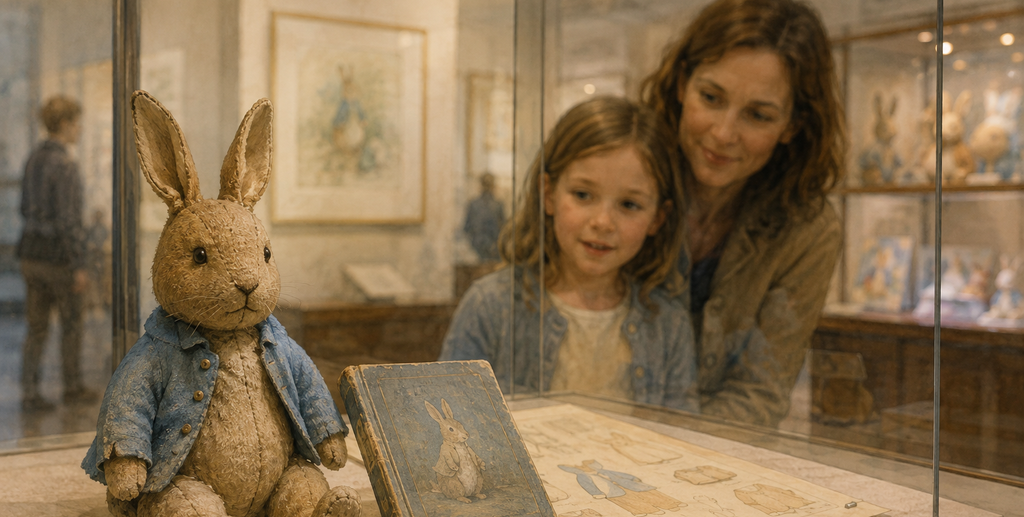
More than a century later, Peter Rabbit exists in books, toys, clothing, homeware, films, exhibitions and experiences. In 2025, Penguin Ventures announced a new licensing partnership for the United States and Canada covering products from toys and clothing to home and gift items. The programme looked ahead to Beatrix Potter's 160th anniversary in 2026 and Peter Rabbit's 125th anniversary in 2027.
The scale would be foreign to Potter, but the basic structure would not. A character moves across formats; a rights holder selects partners; products must remain recognisable; each new encounter either adds to or subtracts from public trust. What began with a handmade doll has become an international system.
It would be easy to end by praising Potter as a business genius who predicted modern entertainment. That would flatten her again. She did not build a corporate empire in the present sense, and not every experiment succeeded. Her achievement was more interesting: she refused to choose between artistic integrity and commercial intelligence.
She wanted children to enjoy affordable books. She also wanted fair royalties. She welcomed useful products and rejected ugly or inaccurate ones. She earned money from Peter, then used creative income to buy farms and protect land in the Lake District. Business was not a betrayal of the story. Properly managed, it gave the story a longer life and gave its creator greater freedom.
For small creators today, this may be the most valuable part of Potter's example. You do not need to turn every idea into a product. You do need to know what your work promises before other people begin to extend it. The clearer that promise is, the easier it becomes to decide what belongs and what does not.
The first Peter Rabbit doll was small enough to sit on a desk. Yet it carried a large idea: a story can leave the page without leaving itself behind.
ピーターラビットは、絵本の外へ飛び出した|本文和訳
一匹のウサギが、物語以上の存在になったとき
1903年12月、ロンドンの机の上に、小さなウサギが立っていました。
茶色い毛、ぴんと伸びた耳、青い上着。
ひと目で誰か分かりますが、紙に描かれた絵ではありません。
ビアトリクス・ポターが自分の手で縫った、ピーターラビットの人形でした。
フレデリック・ウォーン社から『ピーターラビットのおはなし』が出版されたのは、その前年です。本はすでに成功を収めていました。
そして成功したからこそ、新しい問題が生まれます。
ピーターは、小さな白い絵本の中だけにいる存在ではなくなりました。
ほかの誰かが姿をまねて玩具を作り、子どもたちの手に渡るピーターの見た目を決めることもできたのです。
ポターは、今では当たり前に思えることを理解していました。
人気の物語の登場人物は、原作の外でも生きられるということです。
しかし20世紀初頭、現代のようなキャラクターライセンスの仕組みは、ほとんど形になっていませんでした。
作家は本を書き、出版社は本を売り、玩具は別の業界の商品でした。
ポターは、その二つの世界を結び始めます。
彼女はまず、ピーターの試作人形を作り、1903年12月に特許庁でその意匠を登録しました。
ピーターラビット公式年表では、これが長く続く公式商品の出発点として紹介されています。
ピーターを最初期のライセンス文学キャラクターの一つとする研究もあります。
安易に『世界初』と断定するより、ポターは重要な先駆者だったと表現するほうが正確ですが、それでも時代の早さには驚かされます。
優しい水彩画を描く、物静かな女性というポター像だけでは、彼女の全体は見えてきません。
物語が価値を持ち始めたとき、その先を誰が決めるのか。
彼女は、極めて現代的な問いに向き合っていました。
自分の手で作った人形
ポターが最初に用意したのは、ライセンス事業の企画書でも、マーケティング部門でもありません。
布と糸と、はさみでした。
最初の人形は、ピーターを描いた手と同じ手で作られています。
単に商品の表面へ名前を載せたのではなく、紙の上の登場人物を、別の素材へ翻訳しようとしたのです。
素材が変われば、難しい選択が生まれます。
水彩画では繊細に表現できても、玩具には丈夫さが必要です。
立ったり、曲がったり、子どもに持ち運ばれたりしても、ピーターらしく見えなければなりません。
ポターは製造業者を調べ、毛並み、体形、表情、服装まで細かく確認しました。
手紙などをもとにした研究によれば、英国国内での製造を望み、店頭に並ぶ不格好なウサギの玩具を嫌っていたといいます。
それは、作家の気難しさだけではありません。子どもは細部を通して登場人物と出会います。
青い上着、注意深く立った耳、少し不安そうなのに前へ進んでしまう雰囲気。
名前が書かれていなくても、それらがピーターだと教えてくれます。
顔や体形が崩れれば、読者が感じていた親しみまで弱くなります。
商品は物語世界を広げることも、静かに傷つけることもあると、ポターは理解していました。
ここには、創作を広げるときの大切な視点があります。展開や成長というと、商品、形式、市場を増やすことばかり考えがちです。
しかしポターが最初に考えたのは、形が変わっても何を変えてはいけないかでした。
人形は水彩画をそのまま再現できなくても、ピーターらしさを守ることはできます。
現在なら『ブランドの一貫性』と呼ぶでしょう。見本の出来が悪ければ、ポターはもっと率直な言葉を使ったかもしれません。
大切なのは同じです。
最初に愛されたものが、拡大したあとも見失われていないこと。そこではじめて、成長に意味が生まれます。
真剣なルールで作られた『サイドショー』
人形は、一度きりの思いつきではありませんでした。
ポターは物語から派生する企画をいくつも考え、ときに『サイドショー』と呼んでいました。
なかでも興味深いのが、ピーターラビットのボードゲームです。
マグレガーさんがマス目の道を進んでピーターを追いかけ、遊ぶ人は安全な場所を目指します。
編集者で後に婚約者となるノーマン・ウォーンは、試作品の駒を彫って協力しました。
ポターは詳しいルールを書きました。
本人の手紙によれば、口論を防ぐ目的もあったようです。
ゲームは登録されたものの、当時そのまま市場へ出ることはありませんでした。
この未完成は、むしろ大切なことを教えてくれます。
先駆者のすべての商品が成功するわけではありません。
周囲の仕組みが整う前に、可能性を見つけること自体に意味がある場合もあります。
その後も、ぬりえ本、子ども部屋用の壁紙、さまざまな公式商品へと展開が続きました。
ポターは提案を確認し、製造者に対して、動物たちの姿や物語の雰囲気を尊重するよう求めました。
商品は、有名になった物語へ後から貼りつける付属物ではなく、創作世界の一部として扱われていたのです。
この姿を見ると、偶然成功した芸術家というイメージは崩れます。
彼女は価格、判型、印税、所有権を理解していました。
絵本についても、子どもの手に収まる大きさと、家庭で買いやすい価格にこだわっています。
同じ現実感覚が周辺企画にも生かされました。
商品は売る側に都合がよいだけでなく、使う人にとって意味のあるものでなければなりません。
『サイドショー』という呼び方は控えめで、どこか言い訳めいて聞こえます。
しかし、本業の未来が脇道に現れることもあります。
ピーターは、本棚に並ぶ一冊の題名を越え、遊びや物を通じて何度も思い出される存在になろうとしていました。
人気があるだけでは、守れない
人気は機会を生みますが、模倣も呼び寄せます。
無許可の商品や、出来のよくない登場人物の玩具が市場に現れると、ポターは作品を守る意識を強めました。
国によっては著作権の手続きがうまくいかず、すべての複製を止められたわけではありません。
それでも、公式のピーターとは何かを定め、そこに結びつく品質を守ることはできました。
ポターの作品には、よく『愛らしい』という言葉が使われます。
けれども愛らしさは、努力なしに生まれたものではありません。
観察し、描き直し、交渉し、ときには拒否する。
その積み重ねによって作られています。
彼女は印刷を修正し、印税の計算を確かめ、本の大きさや価格について意見を述べました。
商品化にも、同じ厳密さを持ち込みます。
もちろん、管理が強すぎれば、作品を息苦しくすることもあります。
登場人物が生き続けるには、新しい作り手、技術、読者が必要でしょう。
しかしポターは、何も変えてはならないと考えていたわけではありません。
平面のウサギを人形やゲームにした時点で、すでに大胆な変化を受け入れています。
変化はよい。ただし、雑に扱うことは許さない。その違いが重要でした。
この考え方は、自分の仕事が広がり始めたすべての人に関係します。
レシピが商品になり、地域の店が二号店を開き、ブログが本や講座、コミュニティへ発展する。
新しい形は、最初と完全に同じにはなりません。
そこで問われるのは、元の仕事が約束していたものを、次の形も引き継いでいるかどうかです。
ポターの約束は明確でした。丁寧な観察、優れた絵、物としての品質、愚かさに逃げないユーモア、そして子どもへの敬意です。
だからピーターは、紙の外へ出てもピーターでいられました。
彼女が権利を重視した理由も、そこにあります。
守ろうとしたのはロゴだけではなく、読者が作品へ寄せる期待でした。
『見覚えがある』と『信頼できる』で育ったブランド
1世紀以上が過ぎた現在、ピーターラビットは絵本、玩具、衣類、生活用品、映画、展覧会、体験型イベントの中にいます。
2025年には、ペンギン・ベンチャーズが米国・カナダでの商品展開に関する新しいライセンス提携を発表しました。
玩具や衣類、家庭用品、ギフトなどを対象とし、2026年のポター生誕160周年と、2027年のピーターラビット125周年を見据えた展開です。
その規模にはポターも驚くでしょう。しかし基本の仕組みは、彼女が始めたものと大きく変わりません。
登場人物が複数の形式へ移り、権利を持つ側が提携先を選び、商品には見覚えのある姿が求められます。
そして新しい接点の一つひとつが、人々の信頼を増やすことも、減らすこともあります。
手縫いの人形から始まった試みは、国際的な仕組みになりました。
ここで、ポターを現代の娯楽産業を予見した経営の天才として持ち上げすぎると、また人物像を平らにしてしまいます。
彼女が今日の意味で巨大企業を築いたわけではなく、すべての試みが成功したわけでもありません。
もっと興味深いのは、芸術的な誠実さと商業的な判断力のどちらかを、捨てる必要はないと示したことです。
子どもには買いやすい本を届けたい。
同時に、自分には正当な印税が支払われてほしい。
意味のある商品は歓迎し、醜く不正確な商品は拒む。ピーターから得た収入は、やがて湖水地方の農場や土地を買う力にもなりました。
商売は物語への裏切りではありません。
丁寧に管理すれば、作品の寿命を延ばし、作り手の自由を広げることができます。
小さな発信を続ける私たちにとっても、これは大切な示唆です。
すべてのアイデアを商品にする必要はありません。
ただ、自分の仕事が何を約束しているのかは、ほかの人がそれを広げ始める前に知っておく必要があります。
約束が明確であるほど、何を加え、何を断るべきかを判断しやすくなります。
最初のピーターラビット人形は、机に置けるほど小さなものでした。
しかし、そこには大きな考えが込められていました。
物語は、物語らしさを置き去りにせず、紙の外へ出ていけるのです。
おわりに
ピーターラビットの人形を作ったという事実だけを見ると、ポターの先見性に驚かされます。
しかし、より印象に残るのは、商品を増やすことよりも、ピーターらしさを守ることに力を使っていた点です。
作品が注目され始めると、『もっと広げること』が成功のように見えてきます。
形式を増やし、発信先を増やし、商品を増やす。
けれども、広がった先で最初の魅力が薄れてしまえば、規模は大きくなっても、作品そのものは小さくなってしまうかもしれません。
ポターは変化を拒んだのではありません。水彩画のピーターを布の人形へ変え、絵本の物語をゲームのルールへ変えました。
その一方で、表情、体形、品質、価格、子どもへの敬意という核は譲りませんでした。
変えないために同じ形へ閉じ込めるのではなく、核を守りながら形を変える。
その姿勢が、1世紀を越える生命力につながっています。
私たちの仕事や発信も、いつか思いがけない形へ広がるかもしれません。
そのとき考えたいのは、『何を増やせるか』より先に、『何だけは失いたくないか』という問いです。
今度ピーターラビットの商品を見かけたら、青い上着の向こうに、布と糸を手にしたポターの判断を思い浮かべてみてください。
小さな人形は、作品を成長させることと、作品を守ることが、同じ仕事になり得ると教えてくれます。



 | British English | 1,407 words はじめに ピーターラビットと聞いて、皆さんは何を思い浮かべるでしょうか。青い上着を着たウサギ、マグレガ)