
CEFR B2(中上級) | British English | 1,382 words
はじめに
ピーターラビットと聞いて、多くの人が最初に思い浮かべるのは、青い上着を着た小さなウサギでしょう。
食器や文具、ぬいぐるみに描かれた姿は、子ども時代の安心感や英国らしい田園風景と結びついています。
ところが原作を開くと、物語の冒頭近くで父親がパイにされたと知らされます。
ピーターは庭で追い詰められ、服を失い、濡れ、泣き、ようやく逃げ帰ったあとには体調を崩します。
記憶の中の『かわいいお話』より、ずっと身体的で危険な物語です。
ただし、ここで『本当は残酷な絵本だった』と驚かせたいわけではありません。
興味深いのは、ポターが危険を隠さず、それでも物語を重くし過ぎなかったことです。
菓子パンと死、野菜の美しさと空腹、青い上着と逃走の妨げが、同じ小さな世界に自然に並んでいます。
今回のエッセイでは、大人の目で原作を読み返し、ピーターのかわいさを支えている危険、失敗、身体感覚をたどります。
子どものころには冒険として読んだ場面が、親の不安や、生きて帰ることの重さを含んで見えてくるかもしれません。
Why Peter Rabbit Is Not Just Cute
A Pie in the First Few Pages
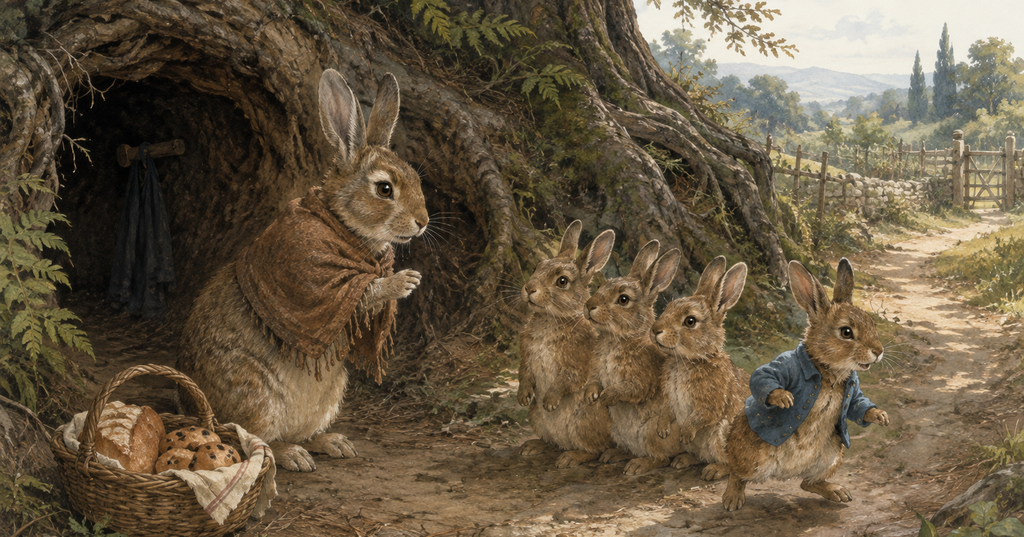
Peter Rabbit is now so familiar that it is possible to recognise him without remembering his story. A blue jacket, two upright ears and a basket of garden vegetables are enough. On cups, towels and nursery walls, he often appears as a small emblem of English comfort. The original book, however, does not allow comfort to arrive before danger.
Near the beginning, Mrs Rabbit warns her children not to enter Mr McGregor's garden. Their father, she explains, had an accident there and was put into a pie. The sentence is brief, almost domestic. Potter does not slow down for mourning, describe violence or turn the dead father into a ghost. She simply places his fate beside the morning instructions, then sends Mrs Rabbit to buy bread and currant buns.
That calmness makes the detail more powerful. Death is not an interruption from another kind of story. It belongs to the same world as shopping, breakfast and children going out alone. The rabbit family lives beneath a tree, but it also lives with a history. Mrs Rabbit's warning is not nervous imagination. It comes from experience.
For a child, the pie establishes the rule of the adventure: Peter may not come home. For an adult, it changes the emotional position of his mother. She is not merely the conventional parent who says no before the fun begins. She is a widow trying to give freedom to children in a place where freedom has already cost the family something.
Potter does not use cuteness to deny this fear. She uses it to make the fear bearable. The small rabbits, the basket and the buns invite us close; the father's fate tells us that closeness will not make the natural world harmless.
The Garden Is Both Feast and Trap
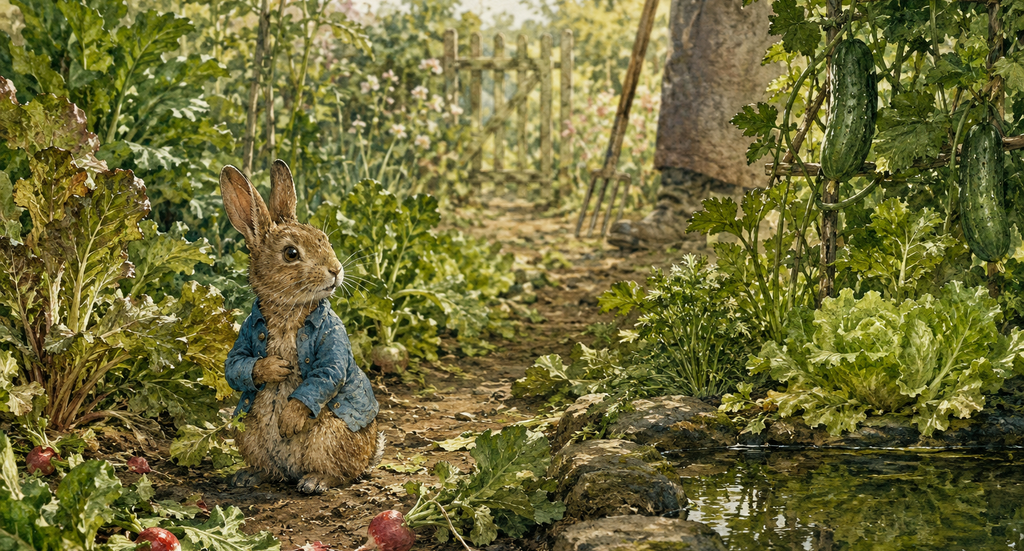
Peter enters the garden because it is full of food. He eats lettuces, French beans and radishes, then feels sick and looks for parsley. The list sounds comic when read aloud, and the pictures turn vegetables into a landscape at rabbit height. Yet the pleasure has an edge. This abundance has been planted, watered and claimed by someone else.
The garden therefore holds two truths at once. To Mr McGregor, Peter is a thief destroying a crop. To Peter, the rows of leaves are almost irresistibly edible. One creature sees property; another sees food. Potter does not pause to solve the disagreement. She lets the chase begin inside it.
Peter is also both eater and possible food. His father became a meal. At the pond, Peter notices a cat watching goldfish and wisely leaves without speaking to her. That quiet image briefly widens the story beyond one angry gardener. Everywhere in this beautiful little world, living things are hungry, and one animal's appetite may become another animal's danger.
This is where Potter's close observation of nature matters. Her animals wear clothes and speak, but they never become human beings in fur. Peter can stand upright, yet he needs a gap beneath a gate. He can wear shoes, yet his speed depends upon four legs. The fantasy works because the rabbit remains physically a rabbit.
Calling the book merely cute removes this double vision. The vegetables are charmingly painted and genuinely desirable; they are also the reason Peter is hunted. The garden is a feast precisely because it can become a trap.
When Clothes Become a Danger
Peter's blue jacket may be the most recognisable garment in children's literature. It makes him look ready for a visit rather than a raid. His shoes and brass buttons give him the vulnerable dignity of a child dressed carefully by a parent. They also nearly get him killed.
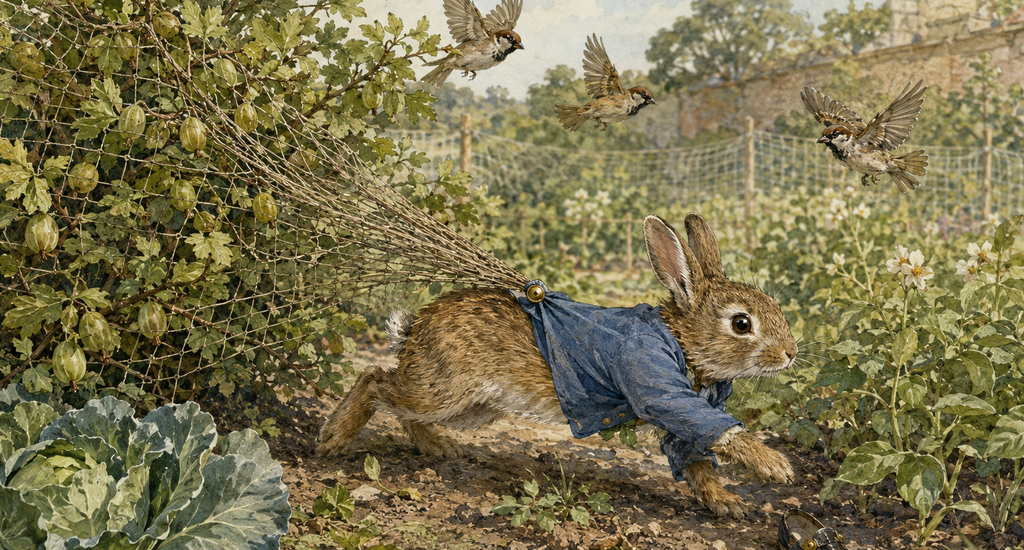
During the chase, Peter loses one shoe among the cabbages and the other among the potatoes. Without them he can run on four legs and move faster. Then the large buttons on his new jacket catch in a gooseberry net. For a moment he believes that he is lost. Sparrows urge him to struggle, and he escapes only by leaving the jacket behind.
The sequence is funny, frightening and surprisingly exact. Clothing makes Peter more human to the reader, but less capable as a rabbit. The costume that creates the familiar image becomes an obstacle when the body underneath it must survive. Potter turns visual charm into part of the plot rather than leaving it as decoration.
The rest of the escape keeps returning us to Peter's body. He is out of breath and trembling. He sits in a watering can and becomes damp. He sneezes in the tool shed. He is too large to fit beneath one locked door, becomes confused, and cries when a mouse cannot answer him. None of these details belongs to a fearless hero.
Children know the world through bodies before they know it through ideas. Wet clothes, a blocked doorway, tired legs and the terror of being lost are understandable without explanation. Potter gives danger a physical scale small enough to enter, but real enough to remember.
He Escapes, but He Does Not Win
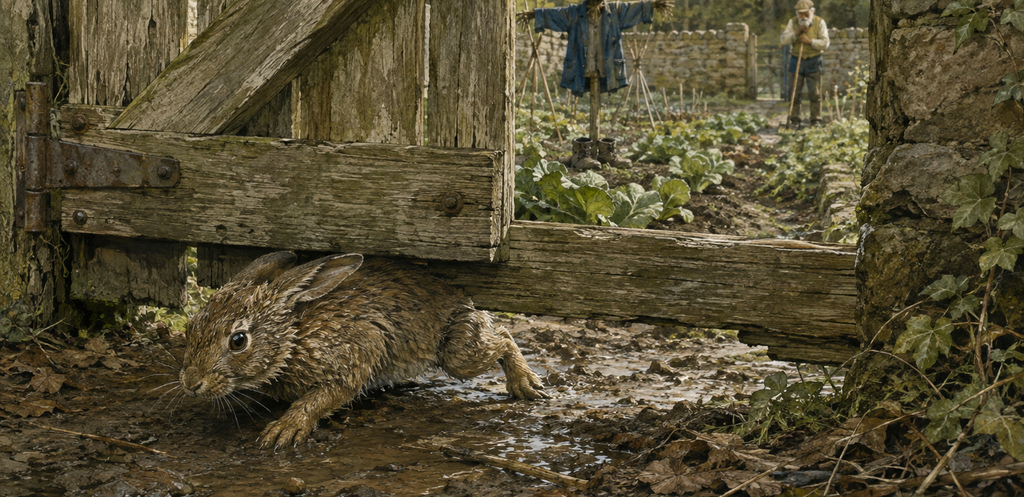
Modern adventure stories often reward a mischievous hero with a clever victory. Peter receives no such triumph. He forgets the way to the gate, is trapped by his own jacket, hides in the wrong container and depends on sparrows, sudden openings and Mr McGregor becoming tired. His courage is mixed with panic and luck.
Eventually Peter sees the gate beyond Mr McGregor and runs for it. The gardener catches sight of him, but Peter is now close enough to safety that the pursuit no longer matters. He slips underneath and keeps running until he reaches home. He has survived the garden; he has not conquered it.
Nor does he return with treasure. Mr McGregor uses the lost jacket and shoes to make a scarecrow. Mrs Rabbit discovers that this is the second set of clothes Peter has lost in a fortnight. That small domestic detail is almost more revealing than a punishment. Peter has done this sort of thing before, and the family must live with the cost of his adventures.
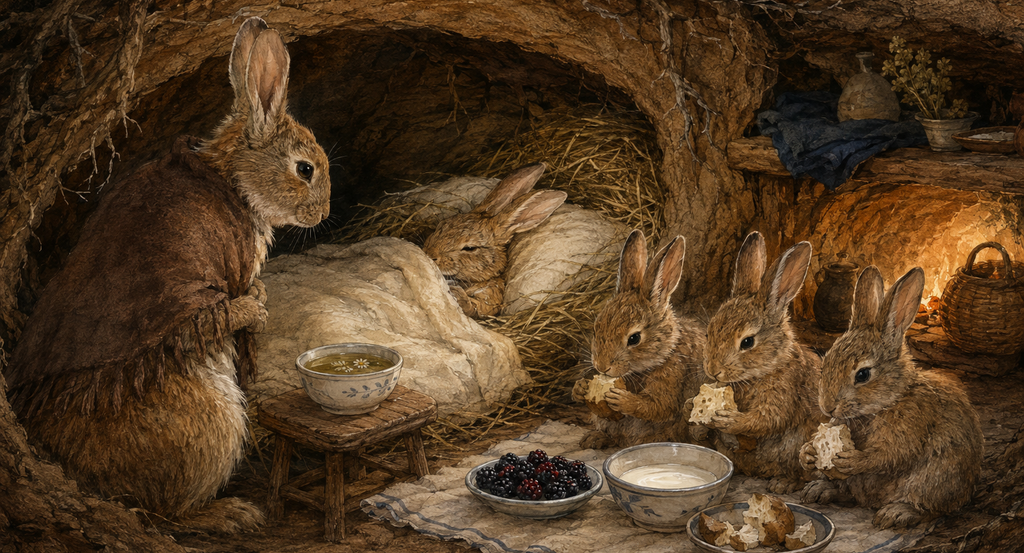
At supper, Peter is ill and receives camomile tea in bed. His sisters eat bread, milk and blackberries. The contrast is gentle but firm. Pleasure has consequences, and those consequences arrive through an aching body and a missed meal rather than through a long speech about obedience.
Potter refuses both extremes. Peter is not rewarded for breaking the rule, but neither is he crushed into submission. He comes home frightened, exhausted and still recognisably himself. The story ends before anyone can claim that he has become good forever.
Cuteness With Consequences
Commercial images often freeze Peter in his clean blue jacket, as if he has not yet reached the gate. Potter's Peter is harder to keep still. He eats too much, loses expensive clothes, cries, makes poor decisions and returns home unwell. His charm does not depend upon perfect behaviour. It depends upon motion, appetite and error.
Adults returning to the book may also notice that it contains a parent's impossible problem. Mrs Rabbit knows the danger and gives a clear warning, but knowledge cannot travel in Peter's place. Once the children leave the burrow, she cannot control what one of them chooses. Parenting here is neither total protection nor careless freedom. It is the painful space between them.
Peter's experience is equally honest from the child's side. Curiosity does not disappear because an adult has a good reason. Fear does not make him noble. He cries, hides and becomes confused, yet continues looking for a way out. Survival is not presented as proof that his decision was wise; it is simply the chance that allows him to return and grow.
The tale lasts because Potter calibrates its darkness. Without the dead father, the chase would be a game with no true stakes. If the father's death dominated every page, the book would lose its lightness and speed. Potter holds the pie, the currant buns, the rake, the sparrows and the camomile tea inside the same small volume. Nothing cancels anything else.
That is why Peter Rabbit is not just cute. Cuteness is the door through which the reader enters, not the room in which the story stays. Behind it are hunger, fear, disobedience, bodily weakness, parental love and the relief of getting home after a mistake. Adults have not outgrown those things. We have only learned to give them less charming names.
ピーターラビットが「かわいいだけ」ではない理由|本文和訳
冒頭近くに置かれたパイ
ピーターラビットは、物語を覚えていなくても姿だけで分かるほど有名になりました。
青い上着、立った2本の耳、庭の野菜。
それだけで十分です。カップやタオル、子ども部屋の壁では、英国らしい安心感を表す小さな印のように見えることもあります。
しかし原作は、危険より先に安心を置いてはくれません。
物語の冒頭近くで、母親は子どもたちにマグレガーさんの庭へ入らないよう注意します。
父親はそこで事故に遭い、パイにされたというのです。
説明は短く、驚くほど日常的です。
ポターは死を詳しく描かず、悲嘆の場面も作りません。
父親の運命を朝の注意事項の横へ置き、そのあと母親をパンとカラント入りの菓子パンの買い物へ出かけさせます。
淡々としているからこそ、この一文は強く残ります。
死は、別の種類の物語から突然入り込む事件ではありません。
買い物や朝食、子どもだけで外出することと同じ世界に存在しています。
木の根元の巣穴で暮らす一家にも、過去があります。
母親の警告は、心配性から出た想像ではなく、経験に基づくものです。
子どもの読者にとって、パイは冒険の規則を示します。
ピーターは帰ってこないかもしれない。
大人が読むと、母親の立場も変わって見えます。
彼女は楽しい冒険の前に禁止を告げるだけの親ではありません。
自由によってすでに家族を失った場所で、それでも子どもたちを外へ送り出す未亡人です。
ポターは、かわいさで恐怖を否定したのではありません。
恐怖を受け止められる形にするため、かわいさを使いました。
小さなウサギ、買い物かご、菓子パンが読者を近くへ招き、父親の運命が、近づいたからといって自然界が安全になるわけではないと伝えます。
庭は、ごちそうであると同時に罠でもある
ピーターが庭へ入るのは、そこが食べ物で満ちているからです。
レタス、サヤインゲン、ラディッシュを食べ、気分が悪くなるとパセリを探します。
声に出して読むと楽しいリズムがあり、挿絵の野菜はウサギの目線に広がる風景になります。
しかし、その喜びには鋭い縁があります。
豊かな野菜は、誰かが植え、水をやり、自分のものとして育てている作物です。
そのため庭には、二つの事実が同時に存在します。
マグレガーさんから見れば、ピーターは作物を荒らす泥棒です。
ピーターから見れば、葉の列は抗いがたい食べ物です。
一方は所有物を見て、もう一方は食料を見ています。
ポターはどちらが正しいかを説明せず、その対立の中で追跡を始めます。
さらにピーターは、食べる側であると同時に、食べられるかもしれない側でもあります。
父親は食事になりました。
池では、金魚を見つめる猫に気づき、話しかけずに立ち去ります。
この静かな場面によって、物語は怒った庭主との対立を越えて広がります。
美しい小さな世界のどこにでも空腹があり、ある生き物の食欲は別の生き物の危険になります。
ここで、ポターの自然観察が効いてきます。
動物たちは服を着て話しますが、毛皮を着た人間にはなりません。
ピーターは後ろ脚で立てても、門の下の隙間が必要です。
靴を履いていても、速く走るには4本の脚を使います。
ウサギの身体を失わないからこそ、空想が本物らしく感じられます。
作品を単に『かわいい』と呼ぶと、この二重の見え方が消えてしまいます。
野菜は魅力的に描かれ、本当においしそうです。
同時に、それがピーターを追われる立場へ導きます。
庭は、ごちそうであるからこそ罠にもなるのです。
服が危険に変わるとき
ピーターの青い上着は、児童文学で最もよく知られた服の一つでしょう。
それを着た姿は、畑へ忍び込むというより、誰かを訪ねるために身支度したように見えます。
靴と真鍮のボタンは、親にきちんと服を着せてもらった子どものような、頼りない品のよさを与えます。
そしてその服が、ピーターを死の寸前まで追い込みます。
逃走中、ピーターは片方の靴をキャベツ畑で、もう片方をジャガイモ畑でなくします。
靴がなくなると4本の脚で走れるため、速くなりました。
ところが新品の上着の大きなボタンが、スグリを守る網に引っ掛かります。
ピーターはもう助からないと思い、スズメたちに励まされ、上着を脱ぎ捨ててようやく逃れます。
この一連の場面は、滑稽で、恐ろしく、しかも身体の仕組みに正確です。
服は読者にピーターを人間らしく見せますが、ウサギとしての能力を下げます。
親しみやすい姿を作っている衣装が、生き延びようとする身体の邪魔になる。
ポターは、かわいらしい装飾を物語の仕掛けに変えました。
その後の逃走でも、読者は何度もピーターの身体へ戻されます。
息を切らし、震え、水の入ったじょうろに座って濡れ、物置でくしゃみをします。
鍵のかかった扉の下には身体が大き過ぎて入れず、道を見失い、ネズミに教えてもらえず泣き出します。
恐れを知らない英雄の姿ではありません。
子どもは、考え方を理解するより先に、身体を通して世界を知ります。
濡れた服、通れない隙間、疲れた脚、迷子になる恐怖なら、説明がなくても分かります。
ポターは危険を、子どもが入っていける小さな尺度にしながら、記憶に残るだけの現実味を失わせませんでした。
逃げ切っても、勝者にはならない
現代の冒険物語では、いたずら好きな主人公が知恵を使って勝利することがあります。
しかしピーターには、鮮やかな勝利が与えられません。
門の場所を忘れ、自分の上着で動けなくなり、隠れる場所を間違え、スズメの励ましや偶然の隙、マグレガーさんの疲れに助けられます。
勇気の中には、混乱と運も入り込んでいます。
やがてピーターは、マグレガーさんの向こうに門を見つけ、そこへ走ります。
気づかれますが、もう安全な場所に近く、追跡は止められません。門の下をくぐり、巣穴へ着くまで走り続けます。
庭から生還はしましたが、庭を征服したわけではありません。
戦利品を持ち帰ることもありません。失った上着と靴は、マグレガーさんによって鳥よけにされます。
しかも母親は、ピーターが2週間のうちに上着と靴をなくすのは2組目だと気づきます。
この小さな家庭の情報は、罰よりも多くを語ります。
ピーターは以前にも似たことをしており、家族はその冒険の費用を引き受けなければなりません。
夕食の時間、ピーターは体調を崩し、ベッドでカモミールティーを飲まされます。
姉妹たちはパンとミルク、ブラックベリーを食べます。対比はやさしい一方で、曖昧ではありません。
楽しみには結果があり、それは長い説教ではなく、痛む身体と食べ損ねた夕食としてやってきます。
ポターは両極端を避けました。
規則を破ったピーターが報酬を受けるわけでも、従順になるまで打ちのめされるわけでもありません。
怖がり、疲れ切り、それでもピーターらしいまま帰宅します。
永遠に『よい子』になったと誰かが宣言する前に、物語は終わります。
結果を伴うかわいさ
商品に描かれるピーターは、門へ入る前のように、きれいな青い上着の姿で止まっていることがよくあります。
ポターの物語の中のピーターは、簡単には静止しません。
食べ過ぎ、高価な服をなくし、泣き、判断を誤り、体調を崩して帰ってきます。
その魅力は、行儀のよさではなく、動き、食欲、失敗から生まれています。
大人になって読み返すと、親が抱える解決不可能な問題も見えてきます。
母親は危険を知り、明確に注意します。
しかしその知識がピーターの代わりに庭へ同行することはできません。
子どもが巣穴を出たあと、一人の選択までは支配できないのです。
ここでの子育ては、完全な保護でも、無関心な自由でもありません。その間にある苦しい距離です。
子どもの側から見ても、ピーターの経験は正直です。
大人に十分な理由があるからといって、好奇心が消えるわけではありません。怖くなっても立派な人物へ変身するわけではなく、泣き、隠れ、混乱しながら出口を探します。
生き延びたことは、庭へ入った判断が正しかった証明ではありません。
帰ってきて成長する機会を得た、それだけです。
この物語が残り続けるのは、暗さの量をポターが正確に調整したからでしょう。
亡くなった父親がいなければ、追跡は本当の危険を伴わない遊びになります。
父親の死が全ページを覆えば、軽やかさと速度が失われます。
ポターは、パイ、菓子パン、熊手、スズメ、カモミールティーを、同じ小さな本の中に置きました。
どれかが、ほかを打ち消すことはありません。
だからピーターラビットは、かわいいだけではないのです。
かわいさは読者が入るための扉であって、物語がとどまり続ける部屋ではありません。
その奥には、空腹、恐怖、反抗、身体の弱さ、親の愛、そして失敗したあとに家へ帰れた安堵があります。
大人になった私たちも、それらを卒業してはいません。
ただ、あまりかわいくない名前で呼ぶことを覚えただけなのです。
おわりに
『子ども向け』『かわいい』という言葉を、私たちはときどき『単純で安全』という意味で使ってしまいます。
しかしポターは、子どもの読者に危険を見せない道を選びませんでした。
怖さを受け止められる形に整えながら、世界には空腹も死もあることを残しました。
ピーターは理想的な子どもではありません。
注意を破り、迷い、泣き、服をなくし、具合を悪くして帰ってきます。
それでも物語は、彼を嫌いになるよう求めません。
失敗した姿のまま愛され、家へ戻ることを許します。
そこに、この絵本のやさしさがあります。
親は子どもからすべての危険を取り除けず、子どもは正しい警告だけで好奇心を止められません。
大人になっても、私たちは十分な注意を聞いたうえで門の下をくぐり、途中で大切なものをなくし、思ったほど立派ではない姿で帰ってくることがあります。
かわいさは、厳しい現実から目をそらすためだけのものではありません。
現実へ近づくための入口にもなります。
ピーターが125年近く走り続けているのは、青い上着が似合うからだけではなく、その上着を失うほど切実に、生きて帰ろうとしたからなのかもしれません。



 | British English | 1,382 words はじめに ピーターラビットと聞いて、多くの人が最初に思い浮かべるのは、青い上着を着た小さなウサギでしょ)